 TI中文支持网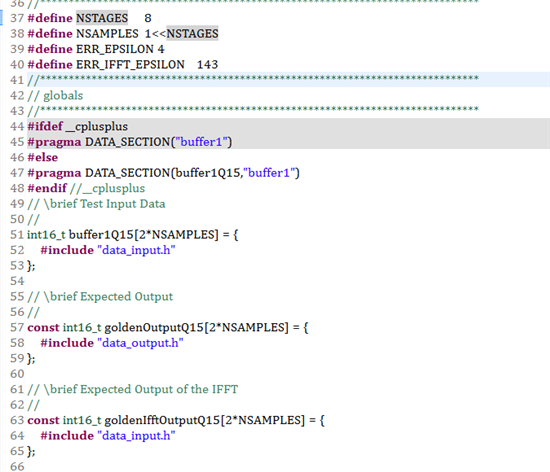
#define NSTAGES 8
#define NSAMPLES 1<<NSTAGES
#define ERR_EPSILON 4
#define ERR_IFFT_EPSILON 143
这些都是什么意思?? 等等 还有buffer1Q15 buffer2Q15 。。。。
同大同:
#include "vcu2_types.h"#include "vcu2_fft.h"#include "examples_setup.h"
//!//! \addtogroup CFFT_EXAMPLES Complex Fast Fourier Transform (N = 256) Example
// @{
//*****************************************************************************// defines//*****************************************************************************#define NSTAGES 8#define NSAMPLES 1<<NSTAGES#define ERR_EPSILON 4#define ERR_IFFT_EPSILON 143//*****************************************************************************// globals//*****************************************************************************#ifdef __cplusplus#pragma DATA_SECTION("buffer1")#else#pragma DATA_SECTION(buffer1Q15,"buffer1")#endif //__cplusplus// \brief Test Input Data//int16_t buffer1Q15[2*NSAMPLES] = { #include "data_input.h"};
// \brief Expected Output//const int16_t goldenOutputQ15[2*NSAMPLES] = { #include "data_output.h"};
// \brief Expected Output of the IFFT//const int16_t goldenIfftOutputQ15[2*NSAMPLES] = { #include "data_input.h"};
// \brief Error Vector//int16_t errorQ15[2*NSAMPLES];
#ifdef __cplusplus#pragma DATA_SECTION("buffer2")#else#pragma DATA_SECTION(buffer2Q15,"buffer2")#endif// \brief Test Output Data//int16_t buffer2Q15[2*NSAMPLES];
// \brief CFFT Object//CFFT_Obj CFFT;
// \brief Handle to the CFFT object//CFFT_Handle handleCFFT;
uint16_t pass = 0;uint16_t fail = 0;//*****************************************************************************// Function Prototypes//*****************************************************************************
//*****************************************************************************// function definitions//*****************************************************************************
//!//! \brief main routine for the 256-sample CFFT example//! \return returns a 1//!//! This example shows how to use the vcu2 supported CFFT routines from the//! library. The input is placed in a section buffer1 that needs to be//! aligned to the size of the input in words to allow the bit reverse//! addressing in stage 1 of the FFT to work properly. The output, however, need//! not be aligned to any boundary unless it is used as the input to an IFFT//!int main( void ){ // Locals int16_t i; int16_t *pTemp;
#ifdef FLASH EALLOW; Flash0EccRegs.ECC_ENABLE.bit.ENABLE = 0; memcpy((uint32_t *)&RamfuncsRunStart, (uint32_t *)&RamfuncsLoadStart, (uint32_t)&RamfuncsLoadSize ); VCU2_initFlash();#endif //FLASH VCU2_initSystemClocks(); VCU2_initEpie();
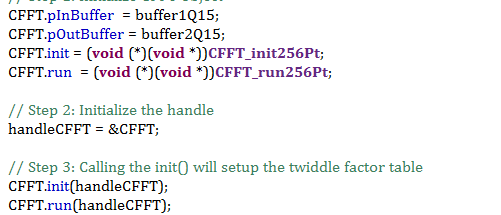
//************************************************************************* // Running the FFT //************************************************************************* //! \b Running \b the \b FFT //! The user starts by initializing the CFFT Object with the appropriate //! init() and run().The init() accepts pointers to the input and output //! buffers and will initialize the other object elements appropriately. //! For the F28X7x devices, the twiddle factor tables are already present //! in bootrom. //! \code //************************************************************************* // Step 1: Initialize CFFT object CFFT.pInBuffer = buffer1Q15; CFFT.pOutBuffer = buffer2Q15; CFFT.init = (void (*)(void *))CFFT_init256Pt; CFFT.run = (void (*)(void *))CFFT_run256Pt;
// Step 2: Initialize the handle handleCFFT = &CFFT;
// Step 3: Calling the init() will setup the twiddle factor table CFFT.init(handleCFFT); CFFT.run(handleCFFT); //************************************************************************* //! //! \endcode //! //*************************************************************************
// Step 4: Verify the result for(i = 0; i < CFFT.nSamples*2; i++){ errorQ15[i] = abs(CFFT.pOutBuffer[i] – goldenOutputQ15[i]); if( errorQ15[i] > ERR_EPSILON ){ fail++; }else{ pass++; } }
//************************************************************************* // Running the IFFT //************************************************************************* //! \b Running \b the \b IFFT //! The user need not re-initialize the CFFT object if done before. The user //! must take that the pInBuffer pointer points to the input. If running through //! the forward FFT first, as in this example, the pointers pInBuffer and pOutBuffer //! should be switched first //! \code //************************************************************************* // Step 1: Switch the input and output pointers of the CFFT object pTemp = CFFT.pInBuffer; CFFT.pInBuffer = CFFT.pOutBuffer; CFFT.pOutBuffer = pTemp; // Step 2: Assign the IFFT function to the run pointer CFFT.run = (void (*)(void *))ICFFT_run256Pt; // Step 3: Run the routine CFFT.run(handleCFFT); //************************************************************************* //! //! \endcode //! //*************************************************************************
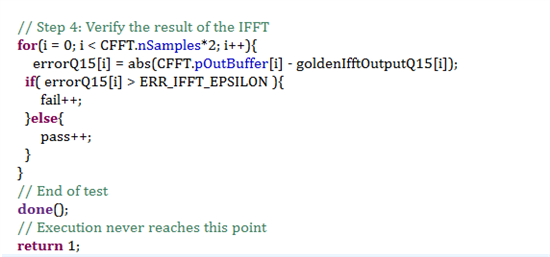
// Step 4: Verify the result of the IFFT for(i = 0; i < CFFT.nSamples*2; i++){ errorQ15[i] = abs(CFFT.pOutBuffer[i] – goldenIfftOutputQ15[i]); if( errorQ15[i] > ERR_IFFT_EPSILON ){ fail++; }else{ pass++; } } // End of test done(); // Execution never reaches this point return 1;}// End of main
// @} //addtogroup
// End of file
#define NSTAGES 8
#define NSAMPLES 1<<NSTAGES
#define ERR_EPSILON 4
#define ERR_IFFT_EPSILON 143
这些都是什么意思?? 等等 还有buffer1Q15 buffer2Q15 。。。。
Terry Deng:
回复 同大同:
CFFT是傅里叶变换的函数,vcu是c2000芯片里面的硬件加速器,可以用来更快的运行CFFT算法。
具体可以参考C28X-VCU-LIB-UG文档的说明
#define NSTAGES 8
#define NSAMPLES 1<<NSTAGES
#define ERR_EPSILON 4
#define ERR_IFFT_EPSILON 143
这些都是什么意思?? 等等 还有buffer1Q15 buffer2Q15 。。。。
user5739360:
回复 Terry Deng:
您好,请问运行这个例程得到的结果应该是什么呢?
新手求教,谢谢您!


